Trading Monsoon Risk: NCDEX Debuts RAINMUMBAI & RAINCHNNAI, India's First Weather Derivatives
Somewhere in a Mumbai trading terminal right now, a number is ticking — and it moves not with earnings calls or central-bank statements, but with the clouds over Santacruz and Colaba. That number is RAINMUMBAI, India's first exchange-traded weather derivative, and as of today it has a sibling: RAINCHNNAI, tracking rainfall a thousand kilometres away on the other coast. Together they turn India's two great rainfall engines — the Southwest Monsoon that soaks Mumbai from June to September, and the Northeast Monsoon that waters Chennai from September to December — into something that has never existed here before: a market where the sky itself is the underlying asset.
What They Actually Are
Strip away the ticker symbols and RAINMUMBAI and RAINCHNNAI are the same idea, applied to two different monsoons. Each is a monthly futures contract built around a running number called the Cumulative Deviation Rainfall (CDR). Every day, IMD's rain gauges record actual rainfall at two designated stations; NCDEX compares that to the calendar day's Long Period Average (LPA — the 30-year climatological normal) and adds the difference to the previous day's CDR. Start the season at an anchor value, and watch the number climb when the rains overperform, or sink when they don't.
- RAINMUMBAI tracks the Southwest Monsoon (contracts for June, July, August, September) at IMD's Santacruz and Colaba stations, anchored to a seasonal LPA of 2,206.7 mm.
- RAINCHNNAI tracks the Northeast Monsoon (contracts for September, October, November, December) at IMD's Meenambakkam and Nungambakkam stations, anchored to a seasonal LPA of roughly 998.3 mm.
Neither is insurance. There's no damage to photograph, no adjuster to convince, no government notification to wait on — the contract settles on a published number, full stop. Think of it less as a safety net and more as a mirror: it simply reflects, in rupees, how far the monsoon strayed from what everyone expected.
How the Machinery Actually Turns
The choreography repeats every single trading day, like clockwork set to the rhythm of the rains:
- 9:00 AM — IMD transmits the previous 24 hours of rainfall from the relevant city's two stations.
- 9:15 AM — NCDEX computes that day's deviation from the LPA and updates the CDR spot, once, for the session.
- 10:00 AM – 11:55 PM — the contract trades, Monday to Friday, at Rs. 50 per millimetre of deviation, up to 50 lots per order.
- Expiry — the business day before the month ends; the Final Settlement Price is simply that day's CDR spot.
- T+2 — every open position is cash-settled. No paperwork, no delay, no argument.
Neither spot resets mid-season — RAINMUMBAI's CDR carries forward from June through September, and RAINCHNNAI's from September through December, so a position taken in month two still reflects everything the monsoon has done since day one.
Who's Actually Standing on Either Side of the Trade
What makes this market interesting isn't the mechanism — it's who shows up to use it. NCDEX built both contracts around a genuinely two-sided economy: businesses that bleed money when rainfall swings, paired against businesses that quietly gain.
- Buyers, hedging the risk: farmers and FPOs guarding against drought or waterlogging, banks and NBFCs protecting agri-loan books from rainfall-driven defaults, power distributors facing costlier procurement when hydro output falls, construction firms hedging monsoon delays, airlines and logistics operators hedging operational disruption, agri-processors hedging raw-material shortfalls.
- Sellers, monetising the exposure: hydro producers who generate more when it pours, solar power firms that thrive on drier, sunnier stretches, agri-exporters with diversified exposure, water-intensive cement and beverage makers, event organisers who prefer dry skies, and financial institutions acting as market makers.
And crucially, this isn't a closed club for institutions. Retail participants can trade either contract through any registered NCDEX commodity member — the same door used for existing commodity futures — though anyone walking through it should understand margin trading first.
The Trade-Offs — What It Fixes, and What It Quietly Doesn't
| Parameter | Traditional Insurance | RAINMUMBAI / RAINCHNNAI |
|---|---|---|
| Trigger | Physical damage must be declared | No loss declaration required |
| Process | Govt. intervention often needed | Exchange-settled, automatic |
| Hedges | Physical crop damage | Income, volume & revenue risk |
| Cost | Higher premium, complex claims | Market-priced, transparent |
| Speed | Delayed, reactive | Daily settlement, real-time |
That speed is real, and so is the transparency — but the fine print matters. Both contracts settle on rainfall at exactly two gauges per city, so anyone hedging a location or crop with a different rainfall pattern inherits basis risk: the payout may simply not line up with the actual loss on the ground. These are leveraged derivatives requiring margin (a minimum 10% of contract value), not a premium-and-payout policy, which demands more financial literacy than buying crop insurance ever did. And neither contract touches physical damage — a farmer whose field washes away still needs insurance for that; RAINMUMBAI and RAINCHNNAI only offset the income and volume side of the shock. Treat them as a complement to insurance, never a replacement — and remember, as NCDEX's own literature is careful to say, that these are risk-management tools, not weather forecasts, and settle on no promise of any particular outcome.
Watching Both Tickers, Live
Here's the catch built into the design: RAINMUMBAI and RAINCHNNAI only tell you where the CDR spot has been — settlement happens after the rain has already fallen. Anyone actually holding a position needs to know where it's headed, and that's precisely the gap VayuMet's Rain Futures Index Desk is built to close: live CDR tracking for both contracts, run forward through a 14-day multi-model projection, checked every day against the official published spot.
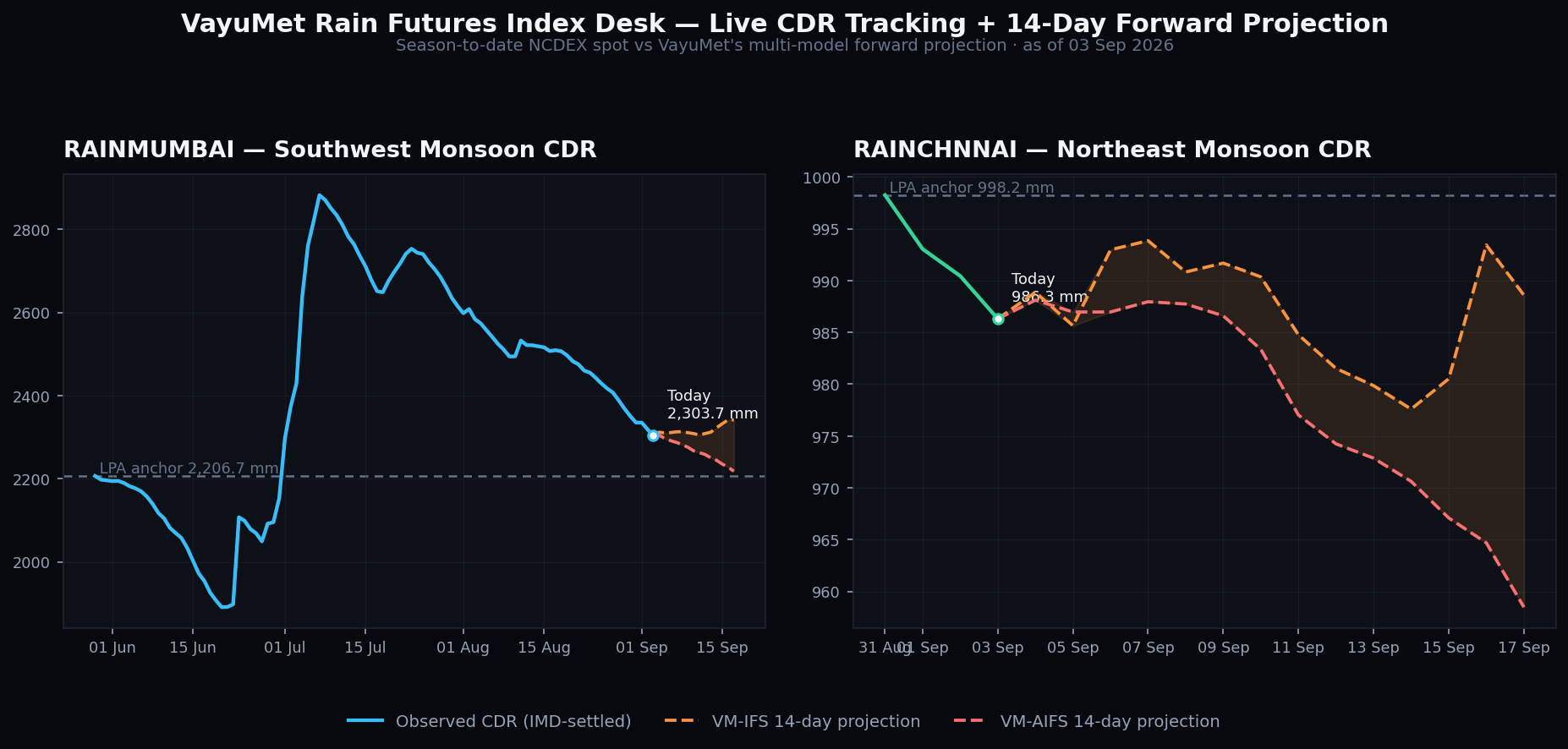
Live desk snapshot, 03 September 2026 · Observed CDR season-to-date vs VayuMet's VM-IFS and VM-AIFS 14-day forward projections
Read what the two panels are actually saying. RAINMUMBAI's season tells a story with a spike in it: the CDR fell to a dry trough of roughly 1,891 mm in late June as onset stumbled, then a ferocious burst of early-July rain rocketed it to a peak near 2,882 mm in a matter of days, and it has been drifting gently lower ever since — sitting at 2,303.7 mm today, still comfortably above the 2,206.7 mm LPA anchor, with both VayuMet models projecting a continued soft decline over the next fortnight. RAINCHNNAI, on the other hand, is a market in its infancy — just days old, opening at its 998.3 mm anchor and already sliding to 986.3 mm as the Northeast Monsoon gets off to a sluggish start. Notice the two Chennai model lines pulling apart toward the edge of the chart: that widening cone isn't noise, it's the desk being honest about how much less certain a 14-day rainfall call becomes for a monsoon that's barely begun.
What Lies Ahead
Between them, RAINMUMBAI and RAINCHNNAI already stretch a tradeable rainfall hedge across three-quarters of the calendar — from the Southwest Monsoon's onset in June through the Northeast Monsoon's retreat in December. That's not the finish line, it's the opening chapter. Weather derivatives are a $25 billion global market, and until RAINMUMBAI's launch, India's share of it sat at exactly zero. Given that the Southwest Monsoon alone drives 75–80% of India's annual rainfall and touches agriculture, power, construction, logistics, tourism, and insurance in equal measure, the runway here looks considerably longer than the eight months these two contracts currently cover. More cities, more rain gauges, and — following the Chicago Mercantile Exchange's decades-old playbook with Heating and Cooling Degree Day futures — perhaps eventually temperature itself, are the natural next chapters in a market that, a few months ago, didn't exist in this country at all.
Comments
⚠ Disclaimer
This article is for educational purposes only and is not investment, trading, or financial advice. Trading in commodity derivatives, including RAINMUMBAI and RAINCHNNAI, is subject to inherent market risk — consult a registered financial adviser before trading or investing. Contract specifications, thresholds, and figures are summarised from NCDEX's own published brochures, FAQs, and product notes as of the current listing; always verify current terms directly on ncdex.com before acting on them. VayuMet is an independent weather analysis platform and is not affiliated with NCDEX, IMD, or SEBI. The CDR figures and chart above are VayuMet's own tracking and forecast of the published NCDEX index — forecasts, not guarantees — and are separate from NCDEX's official settlement data; always verify the live spot on ncdex.com before acting on it.