Weather Intelligence in Aviation — Why It Matters for Safety and Cost
A storm you see three days out is a reroute. The one you don't see is an emergency. In aviation, weather is never a backdrop — it is an operational input that shapes every takeoff, climb, cruise, descent and landing. The quality of the weather intelligence behind those decisions is what keeps a flight safe, on time and economical.
Weather Is an Operational Input, Not a Backdrop
Every phase of a flight is, in effect, a weather decision. Convective storms, clear-air turbulence, airframe and engine icing, wind shear on final approach, low visibility, fog and volcanic ash have all been factors in aviation incidents and accidents. At the same time, weather is a major driver of cost: burnt fuel on reactive reroutes, cascading delays, missed airport slots, disrupted crew rosters and additional airframe stress.
Good weather intelligence changes that equation. When crews, dispatchers and operations teams can see hazards early and precisely, they avoid risk instead of reacting to it — and they plan routes, cruise levels and fuel loads that protect the bottom line on every sector.
Key idea: The shift underway in aviation weather is from generic forecasts to decision-grade intelligence — high-resolution, location- and time-specific guidance delivered when and where the decision is being made.
The Value Case: Safety and Cost Together
The strongest argument for investing in weather intelligence is that safety and cost efficiency are not competing goals — the same early, accurate hazard picture serves both. The table below maps common hazards to their operational impact.
| Hazard | Safety risk | How intelligence adds value |
|---|---|---|
| Cumulonimbus / convection | Severe turbulence, hail, lightning, updrafts | Strategic reroutes planned hours ahead instead of tactical deviations that burn fuel |
| Turbulence (clear-air & convective) | Injuries, airframe stress | Smoother cruise levels selected in advance; fewer unscheduled inspections |
| Icing | Loss of lift, engine and sensor issues | Climb/descent profiles and levels chosen to minimise time in icing bands |
| Jet stream | — | Ride favourable winds and optimise cruise level to cut fuel burn on every sector |
| Fog / low visibility | Approach and departure risk | Realistic alternates and holding fuel planned; fewer diversions |
| Volcanic ash | Engine damage | Advisory-driven avoidance of contaminated airspace |
Beyond individual flights, better forecasts help air traffic managers keep flow rates high without compromising separation in marginal conditions, and help maintenance teams reduce exposure that shortens airframe life. The compounding effect across a fleet is where the economics become significant.
What the VayuMet Aviation Weather Dashboard Provides
The VayuMet Aviation Weather Dashboard is built to close exactly this gap for India and South Asia — turning model output and live aviation feeds into a single, decision-grade picture. It pairs a 10-day significant weather (SigWx) forecast, styled after WAFS (World Area Forecast System) charts, with live airport and airspace conditions.
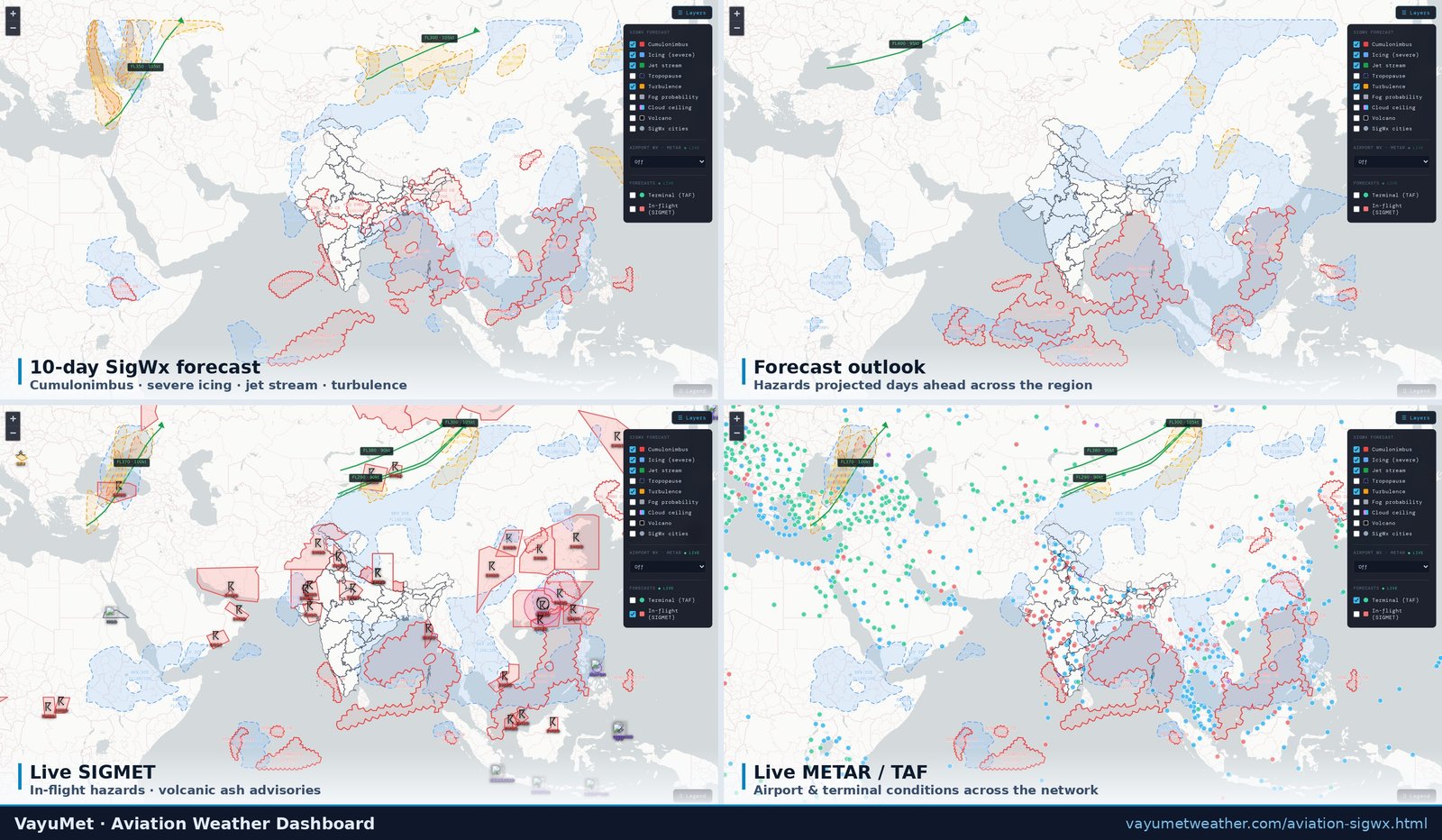
Dashboard at a Glance
Forecast Layers (SigWx)
- Cumulonimbus and convection — coverage (isolated / occasional / frequent), embedding, and cloud-top flight levels.
- Jet stream — jet axes traced through the wind field with speeds and flight levels.
- Turbulence — moderate and severe bands derived from an Ellrod-type turbulence index, tagged by flight level.
- Severe icing — high-humidity supercooled layers with base and top flight levels.
- Tropopause and cloud ceiling — including Instrument (IFR) and Marginal Visual (MVFR) approach conditions.
- Fog probability — a diurnal, surface-level product for departure and arrival planning.
Live Layers
- Airport weather (METAR — Meteorological Aerodrome Report) — flight category, visibility, cloud base and present weather.
- Terminal forecasts (TAF — Terminal Aerodrome Forecast) — station markers with a forecast tray for the hours ahead.
- In-flight hazards (SIGMET — Significant Meteorological Information) — hazard polygons and raw advisory text.
A time slider steps through the forecast, while live layers refresh continuously so the current picture is always current. The whole package is focused on the India and South Asia domain rather than a diluted global view.
From Forecast to Decision
Weather intelligence only creates value when it reaches the point of decision. In practice that means:
- Dispatch and flight planning — route, level and fuel choices made against a 10-day hazard picture instead of a snapshot.
- Operations control — anticipating disruption hours ahead for proactive schedule and crew management, rather than reacting to cascading delays.
- General aviation and business aviation — a single view of convection, icing, turbulence and terminal conditions before a flight.
- Airport and airspace planning — situational awareness of fog, ceilings and convective corridors that constrain capacity.
Safety note: VayuMet's aviation products are independent analysis built on NOAA GFS model output and public aviation feeds, intended for situational awareness and planning. For operational flight decisions, always consult official aviation weather sources, NOTAMs and your national meteorological authority.
The Bottom Line
Better models, denser observations and faster delivery are turning weather from a constraint the industry endures into an input the industry optimises — safer routing, smarter fuel, fewer surprises. In aviation, the weather will always have the final say. The job of weather intelligence is to make sure you are never caught out by it.
Further Reading
- How the GFS Model Forecasts Rainfall in India
- VayuMet Data Sources & Methodology
- Open the VayuMet Aviation Weather Dashboard